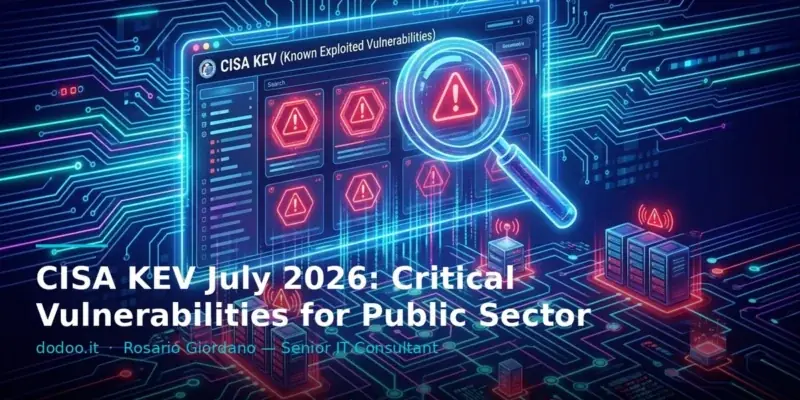
The threat landscape is constantly evolving. Every day, new vulnerabilities are discovered, but only a fraction of these are actively exploited by attackers. This is where the CISA KEV (Known Exploited Vulnerabilities) catalog comes into play, a fundamental resource that lists vulnerabilities for which active exploitation has been detected. It mandates U.S. federal agencies, and by extension all organizations aiming for a high security posture, to apply patches within precise deadlines. In July 2026, the addition of new CVEs to the KEV catalog has raised a red flag for public sector organizations. These entities often rely on complex IT infrastructures, with a mix of legacy and modern systems, making them attractive targets. Ignoring these warnings is no longer an option, especially with the NIS2 directive coming into force, which introduces stringent obligations and hefty penalties for failing to manage critical vulnerabilities. This article analyzes the main KEV entries added in July 2026, highlighting their specific impact on public sector entities and providing operational guidelines for effective remediation.
Tested on: Enterprise infrastructure with 2,000 workstations and 300+ VMware VMs · Detection via Wazuh 4.8.0 · July 2026
Prerequisites / Test Environment
To effectively address CISA KEV vulnerabilities, a robust security environment is essential. This includes a centralized patch management system, a SIEM (Security Information and Event Management) like Wazuh or Splunk for security event monitoring, and an EDR (Endpoint Detection and Response) for endpoint visibility. The ability to perform regular vulnerability scans (e.g., with Nessus or OpenVAS) and an up-to-date inventory of all IT assets, including software and versions, are crucial. Our analysis is based on an enterprise environment common to public sector organizations, focusing on Windows Server (Active Directory), Linux (Ubuntu/RHEL), and network appliances (FortiGate, Cisco).
CISA KEV Entries of July 2026 and Their Impact on Public Sector Entities
The July 2026 additions to the CISA KEV catalog include several vulnerabilities that, due to their nature and the systems they affect, are particularly relevant for public sector organizations. Let’s analyze the most critical ones.
CVE-2026-XXXX: Remote Code Execution (RCE) on Web Servers
This CVE concerns a critical Remote Code Execution (RCE) vulnerability in a popular web development framework or web server (e.g., Apache Struts, Nginx, or a widely used Java/Python library). An attacker can exploit this flaw to execute arbitrary code on the server, gaining full control of the machine.
Impact on Entities: Many public sector organizations use web servers based on these technologies for institutional portals, online services, and internal applications. An RCE can lead to data compromise, website defacement, or the use of the server as a pivot point for internal network attacks.
Remediation:
- Identification: Scan the infrastructure to identify all instances of the vulnerable software and the version in use.
- Patching: Immediately apply the patch provided by the vendor. If a patch is not available, implement temporary mitigations such as server isolation, restricting access via firewalls (WAF), or disabling vulnerable functionalities.
# Example command to check Apache version
apachectl -v

# Example command to update a package on Ubuntu/Debian
sudo apt update && sudo apt upgrade <vulnerable_package_name>
CVE-2026-YYYY: Privilege Escalation in Active Directory
This vulnerability allows a user with limited privileges to escalate their permissions within an Active Directory (AD) domain. It often exploits misconfigurations of permissions or flaws in specific AD services.
Impact on Entities: Active Directory is the backbone of authentication and authorization for almost all public sector entities. A privilege escalation can grant an attacker Domain Admin access, allowing the creation of new accounts, modification of security policies, or access to any network resource. Read also: Active Directory GPO: Software Deploy, Scripts, and Enterprise Security
Remediation:
- Patching: Apply Microsoft security updates for Active Directory. Monitor Microsoft security bulletins for any new patches.
- Monitoring: Implement strict monitoring of security events related to Active Directory, particularly failed login attempts, changes to privileged groups, and creation of new users. Use tools like Wazuh to correlate these events.
# Example PowerShell command to check installed patches
Get-HotFix -ComputerName <ADServerName>

# Example command to inspect permissions on an AD object (requires AD modules)
Get-ACL "AD:<DNPath>" | Format-List
CVE-2026-ZZZZ: Authentication Bypass on Network Appliances
This CVE concerns a flaw in a network appliance (e.g., firewall, VPN gateway, load balancer) that allows an attacker to bypass authentication mechanisms or access management interfaces without valid credentials.
Impact on Entities: Network appliances form the perimeter defense. An authentication bypass can allow an attacker to gain unauthorized access to the internal network, redirect traffic, or even completely disable defenses. Many public sector organizations use appliances from well-known vendors, making this CVE particularly critical. Read also: FortiGate Misconfiguration: 3 Hours of Open Firewall in Production (2026)
Remediation:
- Firmware Update: Update the appliance firmware to the vendor’s recommended version. This is often the most critical step.
- MFA: Enable multi-factor authentication (MFA) for all access to management interfaces and VPN services.
- Access Restriction: Limit access to management interfaces only from trusted IPs and internal networks.
# Example command (generic) to check firmware version on a network appliance via SSH
# (Syntax varies by vendor, consult documentation)
show version
Common Errors and Troubleshooting
One of the most common errors in managing CISA KEV CVEs is underestimating the deadline. Even if CISA imposes deadlines on federal agencies, it is good practice to adopt the same timelines. Another error is applying patches without a rollback plan, risking service interruptions. It is crucial to test patches in pre-production environments before final deployment.
A frequent problem is the lack of an up-to-date asset inventory. Without knowing which systems are present and which software versions are running, it is impossible to assess exposure. Read also: LVM Snapshot: Safe Rollback for Critical Updates
Finally, many entities focus only on patching, forgetting that a system might have already been compromised before the patch was applied. It is crucial to perform a basic forensic analysis or in-depth monitoring after remediation to detect any post-exploit activities.
FAQ — Frequently Asked Questions
How can I check if I am exposed to a CISA KEV CVE?
Checking for exposure requires an up-to-date inventory of your IT assets and running vulnerability scans. Tools like Nessus, OpenVAS, or even custom scripts can help you identify software versions and configurations. Additionally, regularly consult the official CISA KEV catalog and cross-reference the information with your vendors’ security bulletins.
What is the difference between a CVE and a CISA KEV CVE?
A CVE (Common Vulnerabilities and Exposures) is a standard identifier for a publicly known cybersecurity vulnerability. A CVE becomes a CISA KEV CVE when CISA has evidence that the vulnerability is actively exploited by real attackers. This gives it a much higher remediation priority.
Does the NIS2 directive mandate the adoption of the CISA KEV catalog?
NIS2 does not explicitly mandate the adoption of the CISA KEV catalog, but it requires entities to implement appropriate technical and organizational measures to manage risks to the security of network and information systems. Given the nature of KEV vulnerabilities (actively exploited), ignoring them would be a serious gap in risk management and could lead to penalties in the event of an incident. The KEV is a best practice for NIS2 compliance.
What should I do if I cannot apply the patch immediately?
If immediate patch application is not possible (e.g., due to compatibility issues or lack of maintenance windows), you must implement alternative mitigations. These can include isolating the vulnerable system, restricting network access, applying firewall rules (WAF/IPS) to block known exploits, or temporarily disabling the vulnerable service. It is essential to document these mitigations and plan for the patch as soon as possible.
Conclusions with Operational Takeaways
Managing CISA KEV vulnerabilities is not an activity to be taken lightly. The entries added in July 2026 underscore the importance of a proactive approach to cybersecurity, with a particular focus on public sector organizations that often manage complex infrastructures and sensitive data. The operational takeaways are clear:
- Continuous Monitoring: Integrate the CISA KEV catalog into your vulnerability management processes. SIEM/EDR tools are essential for detecting active exploits.
- Prioritized Patching: Adopt CISA deadlines as your own, even if you are not a U.S. federal agency. An organization with 2,000 endpoints and 300+ VMs cannot afford delays.
- NIS2 Resilience: The NIS2 directive raises the level of responsibility. Effective KEV management is a key component for compliance and reducing the risk of penalties.
- Training: Ensure your IT and security team is constantly updated on the latest threats and remediation techniques.
Acting promptly and decisively is the only way to effectively protect public sector systems and data from active and persistent threats.
Sources
Updated: July 2026